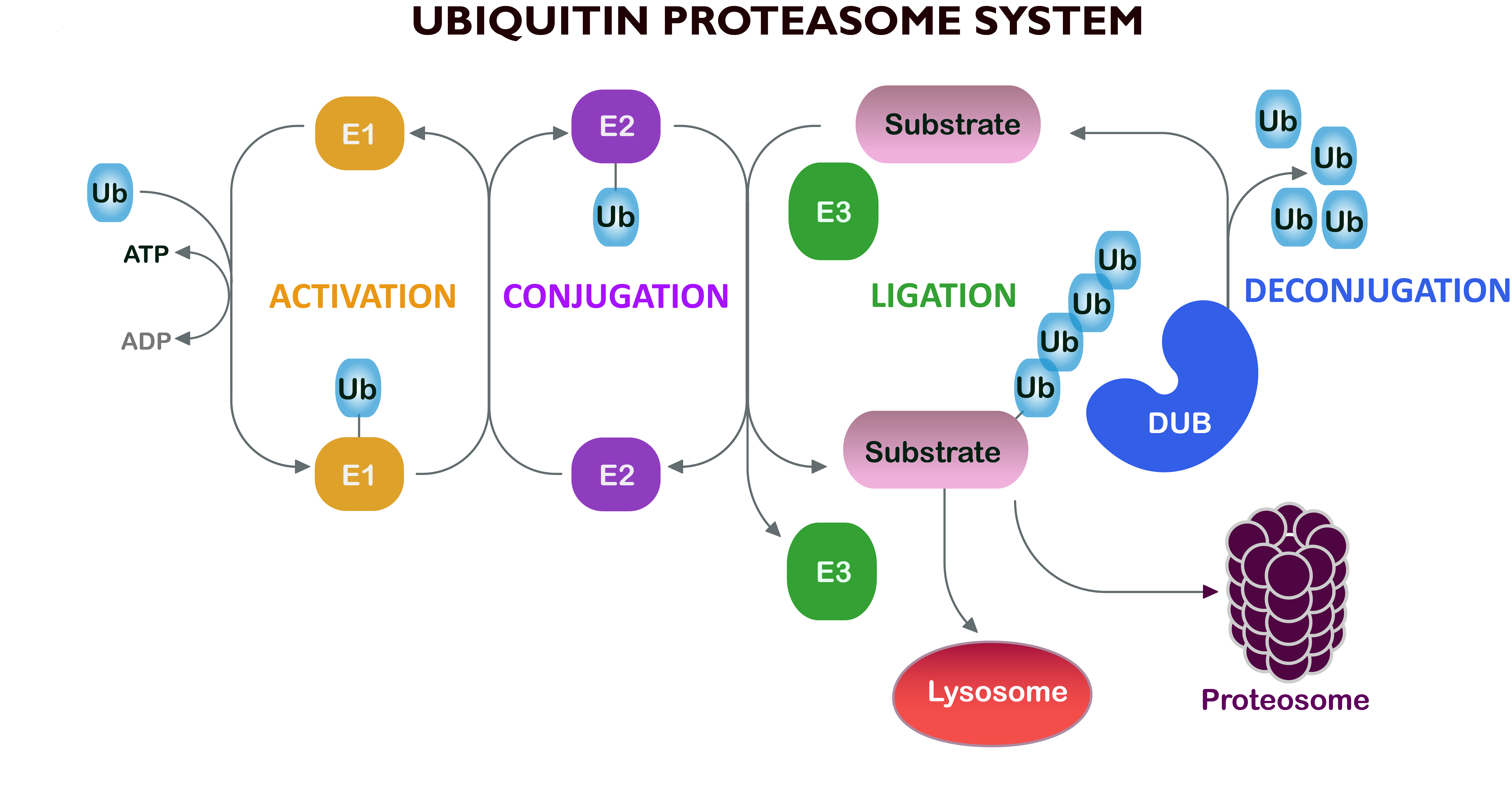
The ubiquitin proteasome system (UPS) is a highly conserved system of the cell that performs many essential functions composed as a cascade of many enzymes that tag the C-terminal of ubiquitin to target proteins.
The ubiquitin proteasome system (UPS) is highly conserved system of the cell that performs many essential functions composed as a cascade of many enzymes that tag the C-terminal of ubiquitin (a highly conserved protein) to target proteins. Frequently, these chains of poly-ubiquitins are built on target proteins.
Pathway Architecture
The Ubiquitin-Proteasome Cascade & Degradation Routes
Sequential transfer of ubiquitin via E1, E2, and E3 enzymes directing cellular fate toward proteasomal or lysosomal clearance.
Chains of lysine 63 poly-ubiquitins on damaged or misfolded proteins lead to degradation of proteins or organelles such as mitochondria by lysosomes (mitophagy).
Lysine 48 linked poly-ubiquitin chains promote target protein degradation by proteasome. Such as degradation of repressor protein in cell nucleus that unleashes PGC1 α a transcription factor that transcribes all the nuclear mitochondrial genes and leads to mitobiogenesis.
Myto Health has established a toolbox of affinity matrices to identify all types of ubiquitin signatures that are hallmarks of disease in humans. This toolbox is employed to establish and discover neurodegenerative biomarkers from blood.
The toolbox is essential for developing assays for ubiquitin ligases and de-ubiquitylases (DUBs). The ligase toolbox is exploited to discover small molecule drugs that promote mitophagy and mitobiogenesis as well as discover natural products and nutraceuticals that improve mitochondrial health and aging.